Wednesday, March 18, 2015

Biggest Snake Yet!

As you know, I'm a reptiles guy. So I'm that odd ball you may have seen walking around campus at night catching geckos and frogs in the creek; This is called "herping". If you hear your mate is going out herping one night, it means he's going to go look for snakes and lizards, and any other reptiles or amphibians he can find.
 Back in the states, I have two good friends that like to go herping with me, but here in Oz everyone seems keen for herping. This is really great to see so much enthusiasm for wildlife, so my mate Harrison and I usually try to assemble a good consortium of hikers for the nights when we go herping.
 This particular night, we were headed out to the Ross River, which is a short 15 minute walk from campus. With our head lamps a lite we searched the grass and scrub-scape for eyeshine. Spider eyes were everywhere, so it takes a trained herper to differ between spiders, toads, frogs, and geckos. Snake eyes generally don't shine as much as other herps, but occasionally they may stick out amongst the habitat.
 It wasn't long until Harrison spotted our first snake. A Brown Tree Snake (Boiga irregularius). This is the species that is wrecking the bird populations on Gaum. They are a pretty hardy and quite common invasive species. I think they are very interesting and pretty. This Colubrid is mildly venomous, but basically harmless. To my surprise he bit me, whilst I was fiddling with my camera and not watching him. First snake bite here in the Southern Hemisphere! Not surprisingly, I had no reaction to the bite, and we carried on to explore the river.
 We noticed several Asian House geckos (H. frenatus), some White Lipped and Green Tree Frogs, Cane Toads everywhere (R. marina) and even a Tawny Frogmouth, which made my bird expert Paul super happy. Then as I swept my light across the trees for gecko eyes I noticed a dull mark, which looked like a Cane Toad in a tree. It was just interesting enough for me to take a closer look.
 "Snake guys! I've got a snake here!" I hollered to the group. "Looks like a carpet Python" I said as I looked at it's head and a foot of its body on the branch.

 "Holy crap, man, come look at the rest of this thing" I heard from the other side of the tree. And as I round the tree trunk I noticed a huge body and tail hanging just low enough to grab. Immediately after I grabbed the snake, it tried to pull away! Even so much that it was lifting me off the ground. As it did so, his head came lower on the other side of the branch. So I reached around and grabbed his head, and we were able to tickle him off his branch for a safe capture. After some measurements and pictures, we bid this 2.3m (7'6") female carpet python farewell, and went back to campus.

Tuesday, March 10, 2015

Summarizing Natural Science

It's exciting to discover knowledge about our beautiful world, but sometimes reading the latest in science can be very taxing on the mind. So I've summed two publications about invasive reptile species for your reading pleasure.

Invasive species have a knack for dominating native species like a Hulk on steroids, and the first species I'd like to mention even reminds me of the Hulk. The Cane Toad (Rhinella marina) is 'smashing and bashing' its way right across Australia. Cane Toads eat many native animals but almost nothing eats the Cane Toad because it's toxic to eat. The Cane Toad produces a toxin, called bufadienolides, as a defense against predators.

 This research project http://classic.rspb.royalsocietypublishing.org/content/early/2012/06/11/rspb.2012.0821.full
shows how we can dish the colossal Cane Toad a taste of it's own toxin. . . Literally.

Cane Toad tadpoles will eat other Cane Toad eggs. How crazy is that. When mother Cane Toads hop in the water and lays her eggs, the other baby Cane Toad tadpoles smell her bufadienolide toxins and swim over to gobble up all those eggs. So the researchers tried trapping Cane Toad tadpoles with bufadienolide as lure, and it worked! It may be possible to trap all Cane Toad tadpoles from a body of water in a few days' time.

The next invasive reptile is Boiga irregularis aka the Brown Tree Snake. The researchers http://www.jstor.org/stable/3892747?seq=1#page_scan_tab_contents
wanted to determine if the snake used venom or constriction to kill its prey.

To find the answer, the researchers looked at two groups of Brown Tree Snakes while they were feeding. One group had their venom glands seal, and the other group was left untouched. Since both groups killed their prey in the same amount of time, the researchers concluded that the venom does not play a role in killing the prey.

Sunday, March 1, 2015

A Rippa' Snorkel on the Reef

What is the largest living structure on the planet? Well, it's the Great Barrier Reef of course. This massive 344,400 square km nation of soft and hard corals is home to a vast array of marine life and can even be seen from outer space. I hope that sounded impressive, because words can't begin describe the scope of beauty and life in this thing!

Though I was only swimming over maybe 10-20 square km of the reef today, I had a grouse (terrific) time exploring it.
Coral


Looks like a maze
Here's a Titan Triggerfish

I believe this is some sort of angel fish?


The seas were decently rough on the 2 hour boat ride out to the reef. Our advisers recommend we take sea sickness tablets before the trip. Naturally half of us didn't. I've spent a good chunk of my life rockin' on boats so I felt fine. But I know a few others who got sick and went to chunder over the side of the boat.
Five foota! This whitetip reef shark swam right under me, and
then I swam next to him for a while.

Out on the reef, they set us loose for a few hours to explore the wonders under water. Even from a group of 60, there was plenty of reef to escape into. I was able to float above 2-3m deep areas, as well as free dive down to 15-20m drop offs.


Giant Clam
The coral was beautiful. Several mollusks and other echinoderms decorated the sea scape. Sharks, rays, and turtles were some of the larger fish present, not to mention the plethora of beautiful reef fish. Jelly fish were a fascination for me. We were highly recommended to were stringer suits (thankfully I did) Jelly fish were everywhere in the water, which is great for the turtles as this is a main food for them.

Blue starfish
Jelly, Jelly, Jelly :)

On the 2 hour ride back to shore, my friends and I decided to enjoy the thrill of getting pelted in the face by wind and rain whilst hanging our legs off the front deck to catch a splash if the boat hit a nice wave. It's crazy moments like this that seem to bring the most joy, and what a fine way to end a day out on the reef too.
Blue spotted reef ray just swimming along.

Magnificent Maggie

As part of the study abroad program I am in, we have a few excursions planned into our semester. I'm sure the intent of these trips is to integrate us into the Australian culture, but I view them as a fun get-away that's "free" even though I technically paid for it already.

Today's territory of interest is Magnetic Island, also known to the locals as Maggie Island. This beautiful island reminds me of Hawaii's big island, because it sports a variety of unique habitats from grassy flats to shear rock fields to billabongs, bays, and beautiful beaches. Just a warning to my sheltered friends from the U.S. there are nude beaches, so don't freak out and don't use your phones or cameras if you end up on one when you visit here.


Maggie is close enough to the main land to be home to many of same biota. I was thrilled to find a few Eastern Stripped Skinks and a beautiful Orange-flanked Rainbow-Skink. Sadly no snakes, but we did find a plethora of insects and fantastic plants.


The Island is webbed with foot trails and roads, but if you do plan to hike a fair distance, I would recommend some decent hiking boots. My blistered, shredded feet and flip-flops can attest to that.
Hydration is key. Even though everything becomes sweat in your clothes in short time any ways. The two men we met on the trail came prepared with a cooler of amber fluid (that's beer). Like I said, hydration is key.

After a short 5 hours we jumped back on the ferry and motored back to the main land. Soaked in sun, salt, and sweat; smiling like we knew a cold shower would greet us at our dorms :)


Wednesday, February 25, 2015

Dylan is Down Unda'

Greetings from Queensland, Australia! I'm studying abroad for a semester at James Cook University in Townsville, Australia.
 Studying wildlife in Australia has been a dream of mine ever since I was a little kid watching Steve Irwin on the Animal Planet. Needless to say I was so excited to finally reach one of my life goals!

James Cook University in Townsville is a top notch tropical ecology research institution. They even have a modest sign out front that says so. But the professors here have been some of the funnest and smartest I've ever had.

For instance, when I sit down for Survival of Land Plants both professors usually still have their hiking boots on. One lectures, while the other kicks his shoes off (barefoot is a common thing here) and both professors bandy back and fourth with jokes and the most up to date knowledge on the subject while using a colourful language of swear words and Aussie tongue. I thoroughly enjoy every lecture, and leave class energized to learn more about each subject.
 I've never lived on campus either, but I'm very pleased with my third floor view into the courtyard below. Just up the hall from me is Paul, a very smart birder from Maine. We regularly go out herping/birding. He teaches me about birds and I teach him a little about herps too.
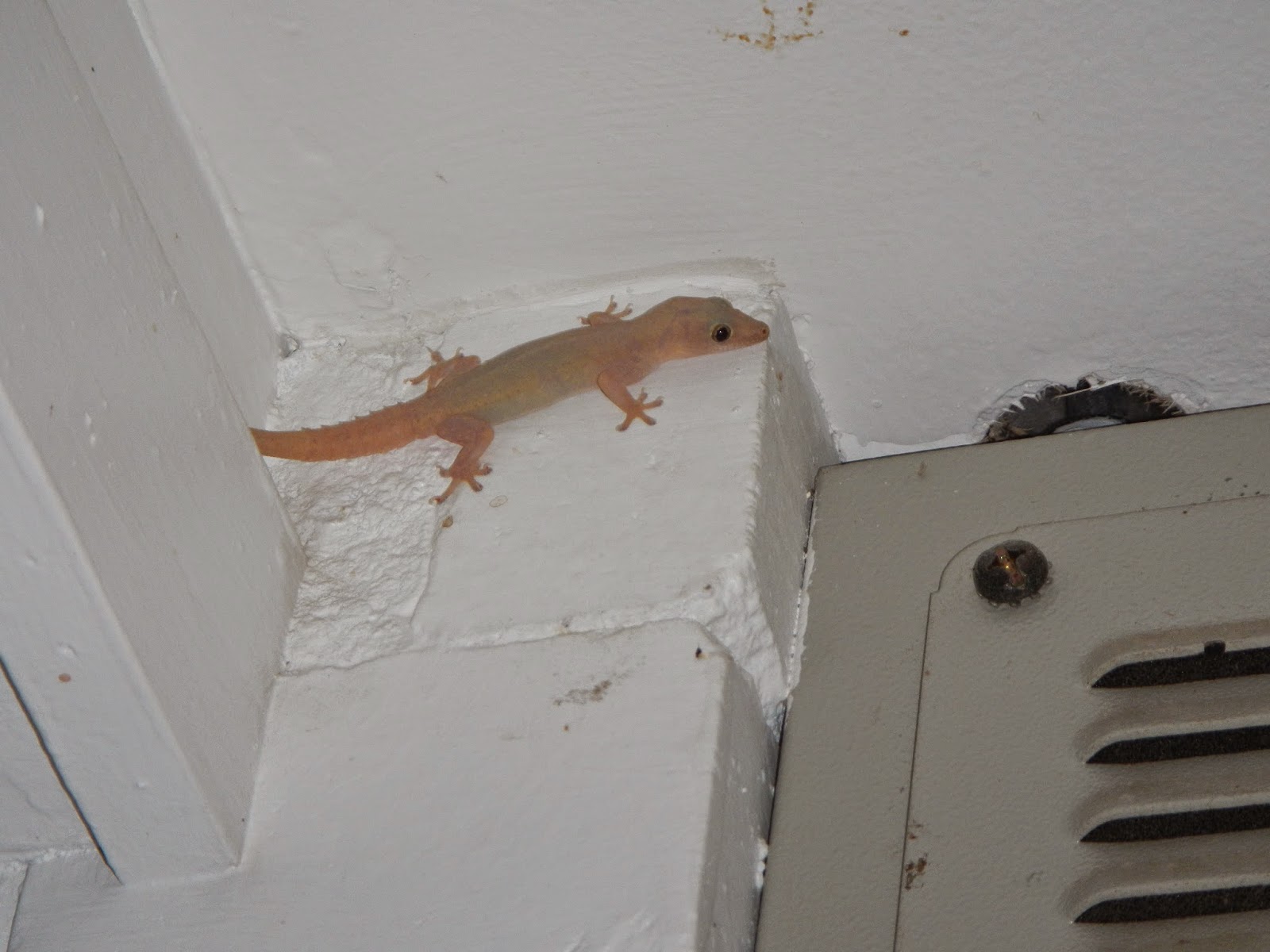
Naturally, going to school in the dry tropics should lend to a good abundance of wildlife. And I don't have to look too far to find a familiar face. This Asian House Gecko Hemidactylus frenatus is my dorm neighbor. Even though H. frenatus is an invasive species here, his frequent chirps in the mornings are kinda nice when everyone else is hung-over and sleeping in.
I'll be sure to keep more frequent updates to the adventure now since I've settled in. Thanks again for reading my blog :)  As my plants professors would say "Cheers and beers!"

Monday, November 3, 2014

Mopack Meadow Vole

     I need to preface this story with another consideration. Last spring I bought a used truck. I got ripped off, and soon realized I had a worthless hunk of metal sitting outside the house. So I sold the thing back in September, at a huge loss, and resolved to just ride my bike everywhere until I left for Australia next Febraury. So now, I bike everywhere, rain, sleet, wind, or shine, and I really like it. Albeit, my bike is showing a little ware and tear.
     So I'm visiting my mom, who lives 12 miles out of town. The good part is there's a nice gravel bike trail, we call the mopack, that goes right past here house only 3/4 miles to the north. So since the evening darkness is coming on cooler and earlier everyday, I fancied the idea of riding back to town in the dark to try to find some mammals on that bike trail. I figure, no one will be out, and there's plenty of cover along the trail. It's a recipe for success!
The Meadow Vole I found tonight.

      So I saddle up on my 1980's Mongoose road bike (it was my dad's bike, back in his college days). My back pockets are stuffed with leather gloves, and a old pillow case, while my camera is strapped to my belt, and my tripod is in my backpack's left water bottle pouch. I flip the peddle lace over my left foot, and swing my right leg over while pressing into the cycle. I click on the red strobe attached to my back side, and press on my white beam head lamp before I hit the road.
     To my great pleasure, I have a nice tail wind tonight. And as I scream down the gravel road hill to the trail, splashing my tires too far to either side into loose gravel, I remember just how sharp I need to be to ride state-maintained gravel roads, as I hit a monstrous wash out at the bottom of the hill. This wash board nearly jumps me off the road. Then out of the corner of my eye I catch a glimpse of rusty red and black fur running up out of the ditch. The tom cat trots right out in from of my 25 MPH blazing hot wheels, and I momentarily wonder if I should even try the brakes. But the cat made it to the ditch fine, and I made it to the trail head fine too.
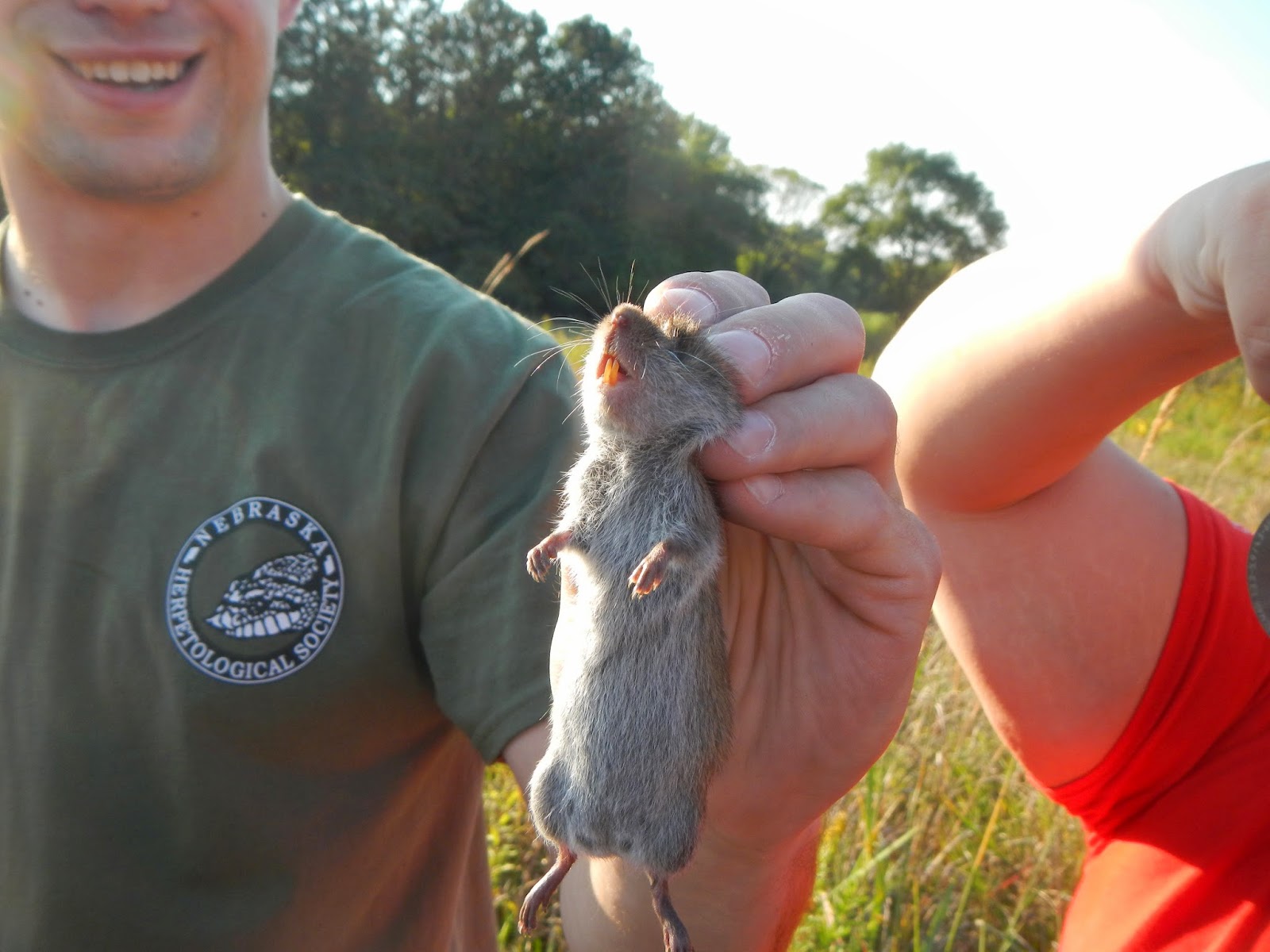
A Vole we caught in mammalogy class

One of the Meadow Voles I caught in
mammalogy class.
      As I beep-bop down the bike trail, I scan the ditches and trees for eyes. For almost 3 miles, all I see is mile markers and street signs. Then a bolt of adrenaline hits my chest, as I see a pair of galloping stars in the road ahead turn into 3 pairs of bouncing eyes. BOOYAH!! We've got action up here. Before I could think about what was happening, I was pedaling at double-time speed, no handle bars, as my hands turn my light beam to bright, and I whip out my camera, and press record while barreling full speed ahead. The 3 nice fat coons, galloped down the ditch and crossed the fence as I approached, and I didn't get a much from this beside hope for more animals ahead.
     As I neared the city, I rode through a village. Only about 3/4 of a mile after the village, I spotted a small brown ball of fur in the rode. A Microtus!!! My mind goes instantly to the Genus name because I just had a Mammalogy test over this a few days ago. This little rodent is commonly known as the Meadow Vole. I ditch my bike right as he heads for the ditch. I dove with cupped hands to gently catch the small mammal, and darn it if my knee cap didn't find the pointiest, most painful rock to jab into!
Selfies! :) -from mammalogy class
     While I set up the filming gear, I reflected on the life history of Microtus pensylvanicus, the Meadow Vole. It is a very prolific breeder, as most food sources for carnivorous animals usually are. The vole reaches sexual maturity after only a few weeks and can raise several litters of young in a year. They don't commonly live longer than a year or two. The Meadow Vole feeds on succulent parts of plants like the leaves, stems, and flowers, but they also eat seeds, and will eat tree bark in rough time. The Meadow Vole is not very fast at escaping capture because it spends most of it's time scampering through it's labyrinth of tunnels through the grass. I was thrilled to have caught the first mammal of this winter's mammal filming season.
     Even though these little guys are cute as a button, I know it's important to remember, they have a roll in the ecosystem as a food source, and nutrient converter much like other animals. So I let the Vole go on his way, and I hopped back on my bike to go on my way. Just enjoying the tail wind and the sense of a mission accomplished.

Thursday, October 23, 2014

It was a Cloudy Dark Night

     At times I reflect on my past experiences, and think about just how I got to where I am today. As I followed the bread crumb trail to the beginning of last summer, I enjoyed one particular night out on the marsh with a friend of mine.
     This was at a time when I needed a few pairs of mating Woodhouse's Toads to use their tadpoles for my research project. The best way to accomplish this task is to go out when these toads are calling and catch them. A friend of mine was also interested in taking a few pictures of these anurans and recording their calls.
     As I finished cleaning a few tanks in the garage at the lab, I could see his red blazer roll into a parking spot in the steady rain. He quickly grabbed his gear bag and jogged up to the wide open garage door to greet me with a "Hello Dilly!" And we began to speculate about the prospects of the night. It was about the right time of year, or so we thought, and a big rain was all we needed, or so we thought.
     While waiting for the sun to go to sleep, the rain storm progressively got thicker and thicker. Pretty soon tidal waves of rain water were rushing down the drive way to the lab, as the water cannons shooting from the down spouts of the gutters flattened grass seven feet out in front of them. We were absolutely giddy! "This kind of rain could make the explosive breeders come out!" "We might see some Spea bombifrons tonight!" "Plains toads too!"
     The rain decided to let up enough for use to dash to the field vehicle and only get mildly soaked, but we had planned on getting drenched in the field anyways. On our drive, my friend Josh narrated a few of his favorite stories from last year when he was out at the marsh filming the frog calls. We were like two kids psyching each other up to go fishing, after watching the Bassmaster Classic on a Saturday morning. We didn't care about anything else, because we were dead sure we were about to see boat loads of frogs and toads.


     Well, to cut right down to the lean cheese, we didn't see a single amphibian that whole night. We wondered through the rain and the marsh like those poor folks lost in the rainy night in that Jurassic Park movie. Only we didn't find a huge T-Rex footprint in the mud, and no dinosaurs came to eat us. But we did find a snapping turtle! This is pretty close to a dinosaur for some people. But what a beauty! She was up 50 meters from the waters edge, wandering across our travel. Of course we did our happy dances and took pictures with her. We're wildlife biology nerds; it's what we do :)
     But in the big picture, it was just a tad bit too early in the season to really find some frog calling action tonight. So goes the life of a field biologist who hasn't had time to develop a reliable field journal yet. But the learning part is a great deal of fun for me too, even if I only find one massive turtle at a time.